Ever since its inception, the Soviet Union sought to show the superiority of communism through its military and space technology. But the Soviets wanted this dominance to be expressed symbolically which led Soviet architectures to plan some really amazing buildings to project this power. Unfortunately*, these idols to communism were never built due to time and budgeting constraints....continue on and you'll see why. (*I say "unfortunately" because one, these would be awesome to see even today; but two, constructing these buildings would of cost the Soviet Union so much money it would of probably sped up the fall communism.) Unrealised Moscow brings us a vision of what could have been...
Aeroflot Building
Building of the People's Commissariat of Нeavy Industry
The Рalace of Technology
Building of the People's Defence Commissariat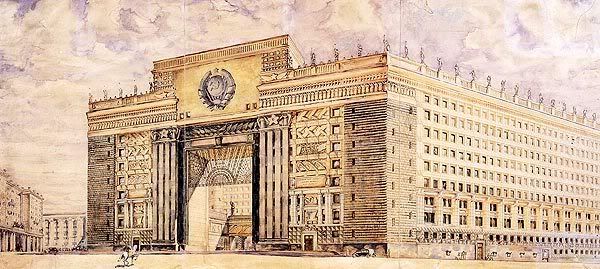
Now Самая грандиозная (the most grandiose)....
Palace of Soviets
View more of these huge unrealized Soviet buildings at Unrealised Moscow.
Saturday, October 4, 2008
Unrealised Moscow


Wednesday, September 24, 2008
Geography of Personality
 The Wall Street Journal recently put out an article focusing on a study found in the journal Perspectives on Psychological Science(pdf). The study, using 60,000 questionnaires, mapped the U.S. based on personality traits (extroversion, agreeableness, conscientiousness, neuroticism, and openness). Then the study overlays data about crime, poverty, and heath to see if there are any correlations. The findings are interesting. But as a psychologist in the article points out, this might only "reinforce stereotypes and tempt us to draw overly simplistic conclusions[,]" going on to say "we tend to reject information that doesn't agree with our stereotypes." Draw your own conclusions...
Monday, September 22, 2008
Lies, Damned Lies, and Statistics
Have you ever wondered which countries have the most corrupt governments? Or which countries have the highest CO2 emissions? Or most liters of beer consumed? All this and whole plethora of other stats can be found at NationMaster.com. It is a collection of user made graphs based off numerical data found from various sources, mainly the CIA Factbook. Though the site looks pretty straight foward, I would caution those who look at these statistics to keep a critical eye on the sources of the data. Remember:
A statistical analysis, properly conducted, is a delicate dissection of uncertainties, a surgery of suppositions.
~M.J. Moroney
Friday, August 22, 2008
Mapping Patterns
Thursday, August 21, 2008
Lasers, Geography, and Radiohead
When I tell people about LiDAR their eyes glaze over and they begin drooling on themselves. Most of them don't grasp the concept of using lasers to geographically map out an area. But, then I tell them how the popular British band, Radiohead, used it to produce a music video. Afterward, I walk away without looking like a drip.
Saturday, March 1, 2008
Capitals
Monday, January 7, 2008
Differences between Eastern and Western culture

Many people have even examined the differences of Eastern/Western culture and psychology through two classic board games, Go (Eastern origin) and Chess (Western origin). Go is a much more holistic, strategic game, starting with a blank board and building up "territory". Whereas Chess is seen as a more linear, tactical game, striving to accomplish one goal, capture the King. By analyzing the game Go, the West can have a significant insight in Eastern strategy which can be used for diplomacy, trade, and even war.
Friday, January 4, 2008
The Shia Revival

Many times when reading about the Middle East and Islamic studies I find the books to be, well, dry. *cough* Bernard Lewis *cough* But being almost finished with The Shia Revival: How Conflicts within Islam Will Shape the Future, I have to say this is one of the exceptions. The book focuses on the formation, spread, and effects of Shia Islam throughout history. Nasir does an excellent job of writing about the particular differences between Shia and Sunni Islam without being bogged down in minutiae. Even if one has little interest in Middle Eastern Studies, I would still recommend taking a gander at this invaluable resource.
Tuesday, July 17, 2007
A Time Lapsed Vacation
I am always interested in time lapse film, especially of places I hope to someday visit. Here are two clips I've come across that were amazing. The first one is of Tokyo and the second is of Antarctica.
Wednesday, June 27, 2007
US States Renamed For Countries With Similar GDPs
 click image for larger view


